
Understanding the Legal Limits of Private Investigators and Digital Evidence Collection
In today’s digital world, mobile phones, messaging applications, call records, and social media platforms contain a significant amount of personal information. When individuals face matrimonial disputes, suspected infidelity, corporate fraud, employee misconduct, or other personal concerns, one of the most common questions they ask is:
“Can a detective agency access someone’s call details, phone messages, WhatsApp chats, or social media accounts in India?”
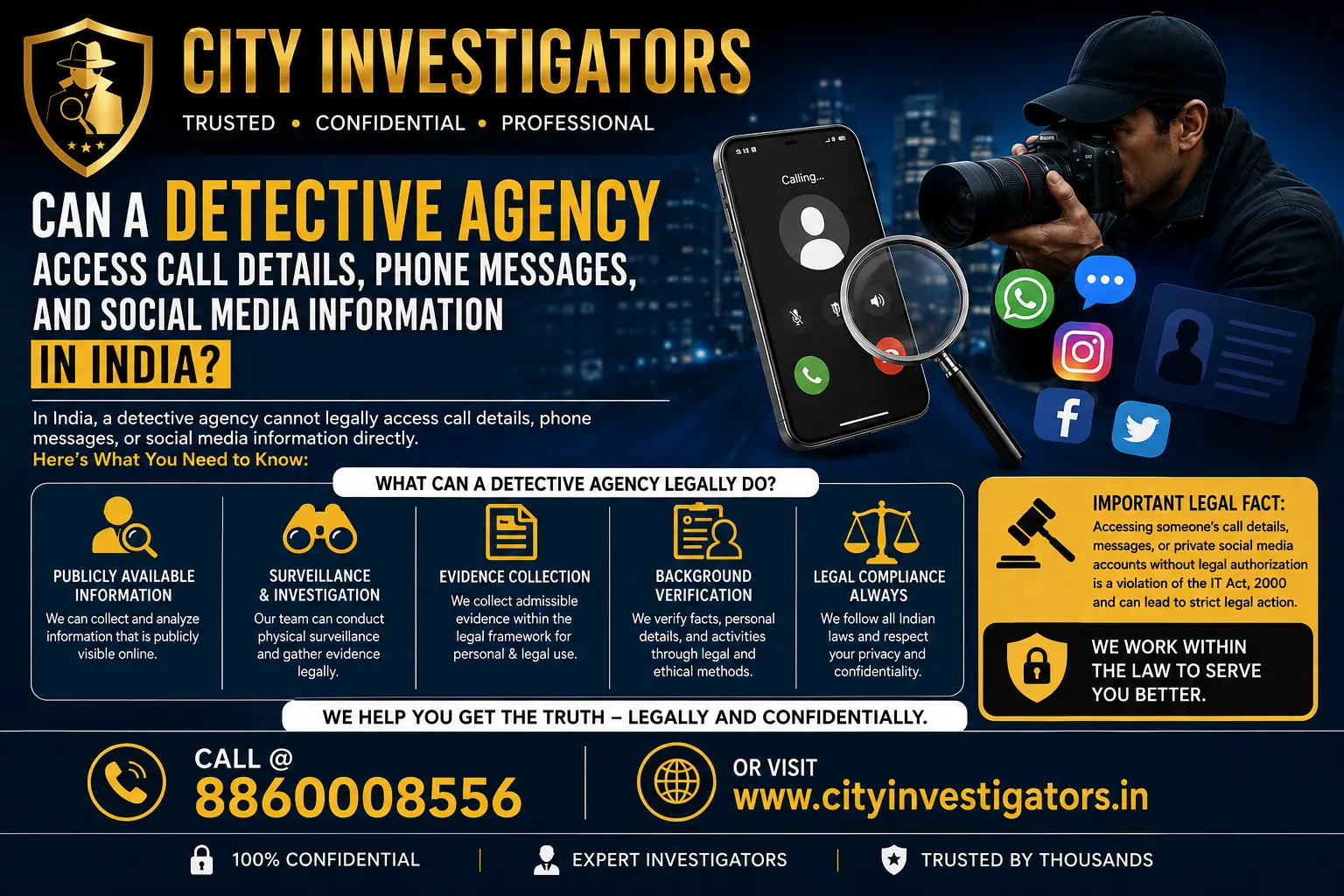
The short answer is: A private detective agency does not have the same legal powers as police, authorised government agencies, courts, or telecom service providers. A professional detective agency cannot lawfully hack a person’s phone, intercept private calls, illegally obtain Call Detail Records (CDRs), or gain unauthorised access to private messages or social media accounts.
However, private investigators can legally collect valuable information through lawful surveillance, open-source intelligence, background verification, public information analysis, witness inquiries, digital footprint research, and evidence documented from legitimate sources.
This article explains what a detective agency can and cannot legally access in India and how professional investigators can help clients collect useful evidence while respecting privacy and applicable laws.
Can a Private Detective Agency Access Call Detail Records (CDR) in India?
A Call Detail Record, commonly known as a CDR, generally contains technical information relating to telephone usage. Depending on the lawful record and context, it may include details such as phone numbers involved, dates, times, duration of calls, and network-related information.
However, an important distinction must be understood:
A Private Detective Agency Cannot Simply Obtain CDRs from Telecom Companies
Private detective agencies are not automatically authorised to demand or obtain confidential Call Detail Records directly from telecom service providers.
Access to telecommunications information is regulated by law and involves privacy safeguards. Telephone interception and access to protected communication data are matters governed by legal procedures and authorised governmental mechanisms. The Supreme Court has repeatedly recognised privacy as a fundamental right and has treated telephone conversations and communications as highly sensitive private information.
Therefore, clients should be cautious of anyone who claims:
• “We can provide anyone’s CDR instantly.”
• “We have direct access to telecom company databases.”
• “We can obtain WhatsApp chats without permission.”
• “We can hack any mobile phone.”
• “We can secretly intercept live calls.”
Such claims may involve illegal activity, fraud, or unauthorised access to personal information.
A legitimate investigation agency should not promise unlawful access to protected telecom databases.
Can a Detective Agency Listen to or Record Someone’s Phone Calls?
Unauthorised interception of private telephone communications raises serious legal and privacy concerns.
Indian courts have recognised that telephone conversations form part of an individual’s private life and that interception must follow a procedure established by law. Government interception mechanisms themselves are subject to statutory safeguards and authorized procedures.
Therefore, a private investigator should not:
• Secretly tap someone’s phone.
• Intercept live calls.
• Install spyware without lawful authority.
• Obtain private call recordings through unauthorised means.
• Access another person’s mobile device without permission.
Professional investigation should focus on lawful evidence collection rather than illegal surveillance or hacking.
Can a Detective Agency Access WhatsApp Messages or Private Phone Chats?
This is another frequently searched question:
“Can a detective agency recover deleted WhatsApp chats?”
“Can a private investigator read someone’s WhatsApp messages?”
“Can a detective agency access Instagram DMs?”
The legal answer depends heavily on ownership, consent, lawful authority, and the method used to obtain information.
A private investigator should not gain unauthorised access to:
• WhatsApp accounts
• Instagram accounts
• Facebook accounts
• Email accounts
• Private messages
• Password-protected devices
• Cloud storage
• Private photographs
Simply because a person is suspicious of their spouse, employee, partner, or another individual does not automatically give a private investigator the legal authority to hack into that person’s digital accounts.
Unauthorised access to computer resources and digital information may attract legal consequences under applicable Indian laws.
What Can a Detective Agency Legally Investigate?
Although private investigators do not have police powers, professional detective agencies can conduct several types of lawful investigations.
Physical Surveillance
Surveillance is one of the most common investigation methods.
An investigator may observe and document activities occurring in places where observation is lawful and where the investigation does not involve trespassing, stalking, harassment, or other unlawful conduct.
Depending on the circumstances, investigators may document:
- Meetings and movements
- Public interactions
- Business activities
- Travel patterns
- Workplace behaviour
- Publicly observable conduct
The purpose should always be to collect factual information rather than invade private spaces.
Open-Source Intelligence (OSINT)
Open-source intelligence involves researching information that is lawfully available to the public.
This may include:
- Public social media profiles
- Public posts and comments
- Company websites
- Business registrations
- Public court information where accessible
- News reports
- Public directories
- Professional profiles
- Publicly available photographs and videos
A professional investigator can analyse publicly available information without hacking or bypassing security systems.
For example, if an individual voluntarily publishes information on a public social media profile, an investigator may analyse that publicly accessible content.
However, accessing a private account by using stolen credentials or unauthorised methods is entirely different and should not be treated as legitimate investigation.
Can a Detective Agency Check Social Media Information?
Yes—but only within lawful limits.
Social media investigation can involve examining publicly available information such as:
- Public Facebook posts
- Public Instagram profiles
- Public comments
- Public photographs
- Public videos
- LinkedIn profiles
- Public business pages
- Public usernames
- Public interactions and digital footprints
This type of investigation is often useful in:
- Pre-matrimonial investigations
- Background verification
- Corporate due diligence
- Employee misconduct cases
- Online fraud investigations
- Identity verification
However, a professional investigator should not hack, impersonate unlawfully, steal passwords, or bypass security protections to enter private accounts.
Can a Detective Agency Collect Digital Evidence?
Yes, a detective agency can assist in identifying, documenting, preserving, and organising lawfully obtained digital evidence.
For example, evidence may include:
- Public social media posts
- Publicly available photographs
- Public videos
- Emails voluntarily provided by the account owner
- Screenshots supplied by the client
- Electronic records obtained through lawful procedures
- Website archives
- Digital footprints
- Public online statements
However, collecting information and making that information legally admissible in court are two separate issues.
Electronic evidence may require proper authentication and compliance with applicable evidentiary requirements. In 2026, the Supreme Court reiterated the importance of the statutory certification requirements for the admissibility of electronic records such as Call Detail Records.
Therefore, clients involved in litigation should always consult their advocate regarding:
- Admissibility of evidence
- Authentication requirements
- Chain of custody
- Proper preservation of electronic records
- Court procedures
How Can a Detective Agency Help in Matrimonial Cases Without Accessing Private Messages?
Many people believe that a matrimonial investigation is impossible without obtaining phone records or private chats.
That is not necessarily true.
A professional investigation may involve multiple lawful methods, including:
Field Investigation
Investigators may verify:
• Where a person goes
• Whom they publicly meet
• Employment details
• Lifestyle patterns
• Business activities
Background Verification
The investigation may examine:
• Education details
• Employment history
• Family background
• Business information
• Public reputation
Public Digital Footprint Analysis
Investigators may analyse:
• Public social media activities
• Public photographs
• Public connections
• Public statements
Witness-Based Verification
Relevant information may sometimes be verified through lawful inquiries and independent sources.
The objective should be to establish facts through multiple reliable sources rather than relying on illegally obtained data.
Evidence-Based Investigation vs Illegal Data Access
A genuine professional detective agency should understand the difference between:
Legal Investigation
And
Illegal Data Acquisition
A reliable investigation focuses on:
- Observation
- Verification
- Documentation
- Corroboration
- Lawful digital research
- Background checks
- Publicly available information
- Client-authorized information
An unethical operator may claim to provide:
- Bank statements
- Call recordings
- WhatsApp chats
- Private passwords
- Live location
- Telecom database access
Clients should be extremely cautious about such promises.
Privacy concerns surrounding sensitive personal information have received continued judicial attention, including concerns about unauthorised access and misuse of personal data by private entities.
Why Privacy Matters in Private Investigations
India’s constitutional framework recognizes privacy as an important fundamental right.
The landmark Justice K.S. Puttaswamy v. Union of India judgment recognized privacy as intrinsic to life and personal liberty under Article 21 of the Constitution.
This does not mean that every investigation is prohibited.
Rather, it means that investigations should be conducted responsibly and within the boundaries of applicable laws.
A professional investigator should balance two important objectives:
- Helping clients discover relevant facts.
- Respecting legal and privacy boundaries.
Ethical investigation is therefore based on collecting information that can be lawfully documented and independently verified.
What Should You Ask Before Hiring a Detective Agency?
Before hiring a private detective agency, clients should ask important questions.
Ask the Agency:
- What investigation methods will be used?
- Will the investigation comply with applicable laws?
- How will confidentiality be maintained?
- What type of report will be provided?
- How will evidence be documented?
- Will the agency use lawful surveillance techniques?
- What information can legally be investigated?
- What are the limitations of the investigation?
Avoid agencies that guarantee impossible results or promise illegal access to confidential databases.
A trustworthy investigator should clearly explain both the possibilities and limitations of an investigation.
How City Investigators Can Help Clients with Lawful Evidence Collection
City Investigators focuses on professional, confidential, and evidence-oriented investigation services.
Depending on the nature of the assignment and applicable legal boundaries, an investigation may include:
- Pre-matrimonial investigation
- Post-matrimonial investigation
- Divorce case investigation support
- Background verification
- Corporate investigation
- Employee verification
- Surveillance services
- Asset and business verification
- Missing person inquiries
- Fraud-related fact verification
- Public digital footprint research
The investigation strategy should always be customized according to the facts of the case.
Instead of relying on unlawful hacking or unauthorised access to private communications, professional investigators can use a combination of lawful field investigation, public-source research, verification, documentation, and corroboration.
Frequently Asked Questions
Can a detective agency get Call Detail Records in India?
A private detective agency does not have unrestricted authority to obtain confidential Call Detail Records directly from telecom companies. Such information is protected and access is subject to applicable legal procedures and authorized mechanisms.
Can a detective agency access WhatsApp messages?
A professional detective agency should not hack or gain unauthorized access to someone’s private WhatsApp account or messages.
Can a detective agency hack a phone?
No. Unauthorized hacking or access to another person’s device is not a legitimate investigation method.
Can a detective agency monitor social media?
Investigators can analyse publicly available social media information and digital footprints. Accessing private accounts without authorization is a different matter and may be unlawful.
Can detectives collect evidence for divorce cases?
A detective agency may assist with lawful fact-finding, surveillance, background verification, and documentation. The legal admissibility of evidence should be discussed with a qualified advocate.
Is surveillance legal in India?
The legality of surveillance depends on how, where, and for what purpose it is conducted. Surveillance must not involve trespassing, unlawful interception, harassment, stalking, or other prohibited activities.
Can private investigators access deleted messages?
A private investigator should not use unauthorized hacking or illegal methods to access another person’s deleted private communications.
Conclusion: Investigation Should Be Evidence-Based and Legally Responsible
The role of a professional detective agency is not to illegally access private databases, hack mobile phones, or intercept confidential communications.
Instead, a responsible private investigation agency helps clients discover relevant facts through:
- Lawful surveillance
- Background verification
- Public-source intelligence
- Digital footprint analysis
- Field investigation
- Witness inquiries
- Evidence documentation
- Independent verification
When dealing with sensitive matters such as matrimonial disputes, corporate fraud, or personal investigations, it is important to choose an agency that understands both investigation techniques and legal boundaries.
At City Investigators, the focus is on confidential, professional, and evidence-oriented investigation methods designed to help clients make informed decisions while respecting applicable laws and privacy rights.