
Adultery allegations often become one of the most sensitive and emotionally challenging aspects of matrimonial disputes. Whether the issue relates to divorce, child custody, maintenance, or alimony, proving adultery requires credible and legally admissible evidence rather than mere suspicion.
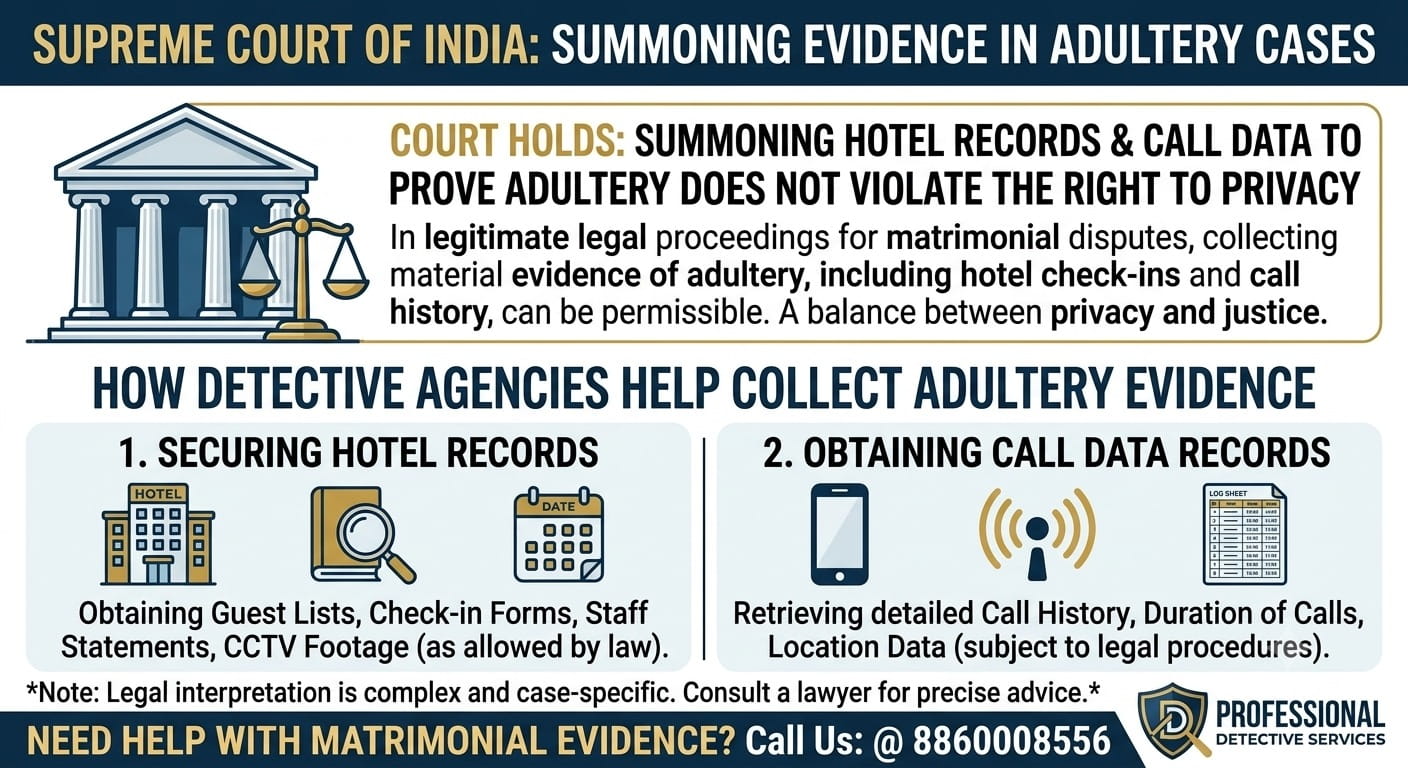
A recent development from the Supreme Court of India has drawn attention to the balance between an individual’s right to privacy and the need for relevant evidence in matrimonial litigation. The Court observed that, in appropriate circumstances and subject to legal procedures, summoning records such as hotel bookings or call detail records (CDRs) for the purpose of adjudicating matrimonial disputes does not automatically amount to a violation of the constitutional right to privacy. Such requests must still satisfy legal requirements and judicial scrutiny.
This judgment highlights the importance of collecting lawful, relevant, and reliable evidence in matrimonial cases.
Understanding the Supreme Court's Observation
The right to privacy is a fundamental right under Article 21 of the Constitution of India. However, like many constitutional rights, it is not absolute.
When a court is deciding a matrimonial dispute involving allegations of adultery, it may permit access to relevant records if:
- The information is directly related to the case.
- There is sufficient justification for seeking the records.
- The request follows the due process of law.
- The evidence is necessary for ensuring a fair trial.
This means that courts can consider documentary and digital evidence where legally appropriate, while still protecting individuals against unnecessary or excessive intrusion into their private lives.
Why Evidence Matters in Adultery Cases
Indian courts generally require strong and convincing circumstantial evidence to establish adultery. Mere allegations, rumours, or personal suspicions are usually insufficient.
Evidence that may assist in matrimonial proceedings includes:
- Hotel stay records (when lawfully obtained through court process)
- Call detail records (subject to judicial approval)
- Photographic or video evidence collected legally
- Location and movement verification
- Witness statements
- Social media activity
- Financial transactions where relevant
- Background verification reports
Each case depends on its own facts, and the admissibility of evidence is ultimately decided by the court.
How a Detective Agency Helps Collect Adultery Evidence
Professional detective agencies play an important role in gathering factual information while maintaining confidentiality and operating within legal and ethical boundaries.
A professional investigator may assist by:
1. Surveillance Investigation
Investigators discreetly observe the activities of the suspected individual and document meetings, movements, and interactions.
2. Photographic & Video Documentation
Where legally permissible, investigators collect photographs and videos that may corroborate suspicious activities.
3. Relationship Verification
Detectives verify whether the suspected individual is maintaining an undisclosed relationship.
4. Hotel Visit Verification
Investigators may document visits to hotels or other locations through lawful surveillance. Official hotel records, where required, are generally obtained only through legal processes or court orders.
5. Digital Intelligence
Open-source digital investigations may include analysis of publicly available social media activity and other legally accessible information.
6. Timeline Reconstruction
Investigators prepare chronological reports showing dates, locations, meetings, and observations that may assist advocates in presenting the case.
7. Court-Support Documentation
Professional agencies prepare detailed investigation reports supported by evidence that may assist legal counsel. The admissibility and evidentiary value remain subject to judicial determination.
Why Choose City Investigators Detective Agency?
City Investigators Detective Agency is one of India’s trusted private investigation firms, providing confidential matrimonial investigation services across the country.
Our experienced investigators assist clients by:
- Conducting discreet adultery investigations
- Collecting legally obtained factual evidence
- Providing detailed surveillance reports
- Documenting photographic and video evidence where lawful
- Verifying suspicious relationships
- Supporting advocates with professionally prepared investigation reports
- Maintaining complete confidentiality throughout the investigation
Every investigation is conducted with professionalism, discretion, and respect for applicable laws.
Important Legal Note
A detective agency cannot legally obtain restricted records such as Call Detail Records (CDRs), phone tapping data, or confidential hotel records through unauthorized means. Such records may only be accessed through lawful procedures, including judicial orders or as otherwise permitted by law.
Clients should always ensure that any investigation is conducted legally so that the evidence has the best chance of being considered in court.
Conclusion
The Supreme Court’s observations reinforce an important principle: while privacy is a fundamental right, courts may permit access to relevant evidence in matrimonial disputes when required for the fair administration of justice and in accordance with legal procedures.
For individuals facing serious matrimonial disputes involving allegations of adultery, professionally conducted investigations can help uncover factual information and support informed legal action. A reputable detective agency works alongside legal counsel to gather lawful, reliable, and well-documented evidence while maintaining strict confidentiality.

